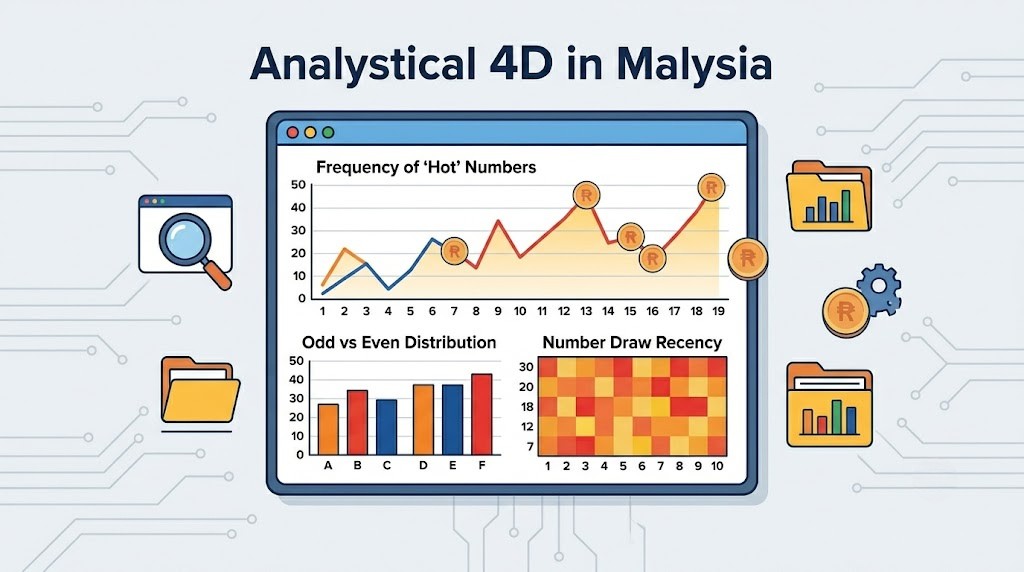
Malaysia 4D statistics show you how often each number has appeared in past draws. Many players use this data to decide which numbers to bet on — but understanding what the different statistics actually mean is the first step. This guide explains the key terms you will encounter on any 4D statistics page and how to read them correctly.
You can explore the full frequency data for Magnum, Da Ma Cai and Sports Toto on 4D Statistics at MY4DLIVE, covering all past draws across each operator.
What Are 4D Statistics?
4D statistics are records of how many times each four-digit number (0000–9999) has appeared as a winning result in past draws. They are calculated from historical draw data and updated after every draw. The most common statistics you will see are:
Hot Numbers — What They Mean
Hot numbers are 4D numbers that have won more frequently than average over a given period. You might see them labelled as "most frequent," "top drawn" or simply ranked by their appearance count.
For example, if the number 1234 has appeared 12 times in the last 200 draws while the average is 6 times, it would be considered a hot number. Some players interpret this as the number being "on a streak" and bet on it expecting it to continue appearing.
From a purely statistical standpoint, each 4D draw is independent — past results do not influence future draws. Hot numbers tell you what has happened historically, not what will happen next. That said, many experienced players track hot numbers as part of their selection process, treating them as one data point among several.
Cold Numbers — What They Mean
Cold numbers are the opposite: 4D numbers that have appeared rarely, or not at all, within a given time window. You might see these listed as "least frequent" or ranked with very low draw counts.
Some players avoid cold numbers entirely, reasoning that if a number has not appeared in a long time, it is unlikely to appear soon. Others deliberately target cold numbers using a theory sometimes called "regression to the mean" — the idea that an underperforming number is statistically "owed" more appearances.
Neither interpretation is more mathematically correct than the other for truly random draws. What matters is understanding what the data represents so you can use it on your own terms.
Overdue Numbers — The Key Difference
Overdue numbers are similar to cold numbers but the concept is more specific. A number is overdue when the gap between its last appearance and the current draw is longer than its historical average gap.
For example: if number 5678 typically appears every 50 draws on average, but has not appeared for 120 draws, it is considered overdue. The gap has exceeded its usual cycle.
Overdue tracking is considered by many 4D players to be more useful than raw frequency counts because it accounts for each number's own historical rhythm rather than comparing it to a fixed average. A number can appear infrequently overall but still not be overdue if it has been appearing on schedule.
How Draw Frequency Is Calculated
Statistics pages typically show draw frequency as the total number of times a number has appeared within a defined period — for example, the last 100 draws, 500 draws or all-time. The longer the period, the smoother and more reliable the frequency data becomes, since short windows can be misleading due to natural variance.
When reading 4D statistics, pay attention to the time window being used. A number appearing 3 times in the last 10 draws looks very hot, but may be completely average when viewed over 500 draws.
Prize Category Breakdown
Some statistics pages separate frequency data by prize category — tracking how often a number appeared as a 1st prize winner versus a Special prize winner. This level of detail is useful if you are betting Big (which covers all prize tiers) versus Small (which covers only 1st, 2nd and 3rd prize).
If your strategy is to target Small bets for higher payouts, looking at 1st-prize-specific frequency data is more relevant than overall appearance counts that include Special and Consolation prizes.
How to Use 4D Statistics Practically
Here is how most experienced players apply statistics to their number selection:
- Set a time window — decide whether you want to look at the last 50, 100 or 500 draws. More draws give smoother, more reliable data.
- Identify your preferred approach — hot number strategy, overdue number strategy, or a mix of both.
- Cross-reference across operators — a number that is hot across Magnum, Da Ma Cai and Sports Toto may carry more weight than one that is only hot with a single operator.
- Track digit patterns — some players focus on digit-level frequency (how often the digit 7 appears in any position) rather than full 4-digit combinations.
- Use statistics as a filter, not a guarantee — narrow your shortlist using data, then apply personal criteria (lucky dates, significant numbers) for final selection.
Important: 4D draws are random events. Statistics describe past outcomes and cannot predict future results. Use frequency data as one reference point in your selection process, not as a prediction tool.
Where to Check 4D Statistics in Malaysia
MY4DLIVE provides full 4D number frequency data updated after every draw. You can filter by operator, time window and prize category to find hot, cold and overdue numbers across Magnum, Da Ma Cai and Sports Toto. After you identify numbers of interest, check the latest 4D Results after each draw to track your picks.
Understanding statistics is one of the more analytical approaches to 4D in Malaysia, and it is entirely possible to develop a consistent selection process once you know what each metric represents. Start with the frequency data, explore the overdue numbers section, and experiment with different time windows to see which view you find most useful.
← Back to Guides